Play Isn’t Just Fun — It’s Foundational
How play supports healing, learning, and connection for children and families
At Aplomb Consulting and Education Solutions, we’ve long believed that play is far more than recess or downtime. According to research highlighted by TIME, play is a deeply meaningful process — one that supports emotional health, social connection, learning and even physical well-being.
The power of play for healing
The article tells the story of a young child in a refugee camp who quietly hid under a table—until volunteers placed a simple building-set nearby, inviting him to “play.” Gradually he emerged, built, shared pieces with others and began to speak again. That moment illustrates how play offers a safe way to express, reconnect, and rebuild.
Early pioneers in play therapy, such as Charles Schaefer and Athena Drewes, identified several domain-wide benefits of play: communication, emotional wellness, social relationships and personal strength. (TIME)
Benefits across ages
While we often think of play in relation to children, the research confirms it’s beneficial for adults, too. Play can be a pathway to release, connection, and healing. One adult therapist working with survivors of domestic violence began sessions with a balloon game—just keeping the balloon aloft created laughter, lowered defenses, and opened space for deeper work.
In terms of physical and mental health: play and laughter have measurable effects such as reduced stress, improved mood and even greater pain tolerance.
Why this matters for schools, families and communities
Play gives children agency, voice and a sense of control. In environments where children and families feel vulnerable or unsure—such as schools in under-resourced or trauma-impacted settings—creating space for meaningful play can be transformational. The article observes that a space where children build, laugh and play—even just a few hours a day—can become a sanctuary for the entire community.
How Aplomb can help
At Aplomb Consulting and Education Solutions, our programs underscore the importance of play-based and hands-on approaches:
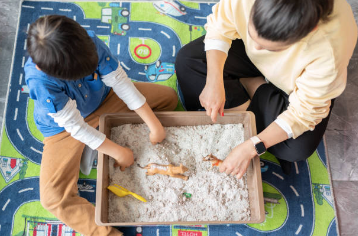
For children: Through play therapy, sand-tray work, and structured hands-on learning, children can express emotions, build resilience and grow socially and academically.
For families: Workshops for parents help them understand how play supports emotional skill-building, connection and regulation at home.
For schools & organizations: Professional development and consultation to create play-friendly, SEL (social-emotional learning)-rich environments—especially in Title I and charter schools, and asset-limited communities, which align with our mission.
Our invitation to you
If you’re ready to make space for play in your home, school or community—let’s talk. Because when we play, we don’t just have fun. We heal, we grow, we connect.
Contact us at info@aplombsolutions.org to explore how we can bring play-based SEL, sand-tray therapy, parent workshops and more to your setting.
